
Best AI Content Repurposing Tools in 2026
Compare AI repurposing tools by source type, editorial control, lineage, format adaptation, and distribution.
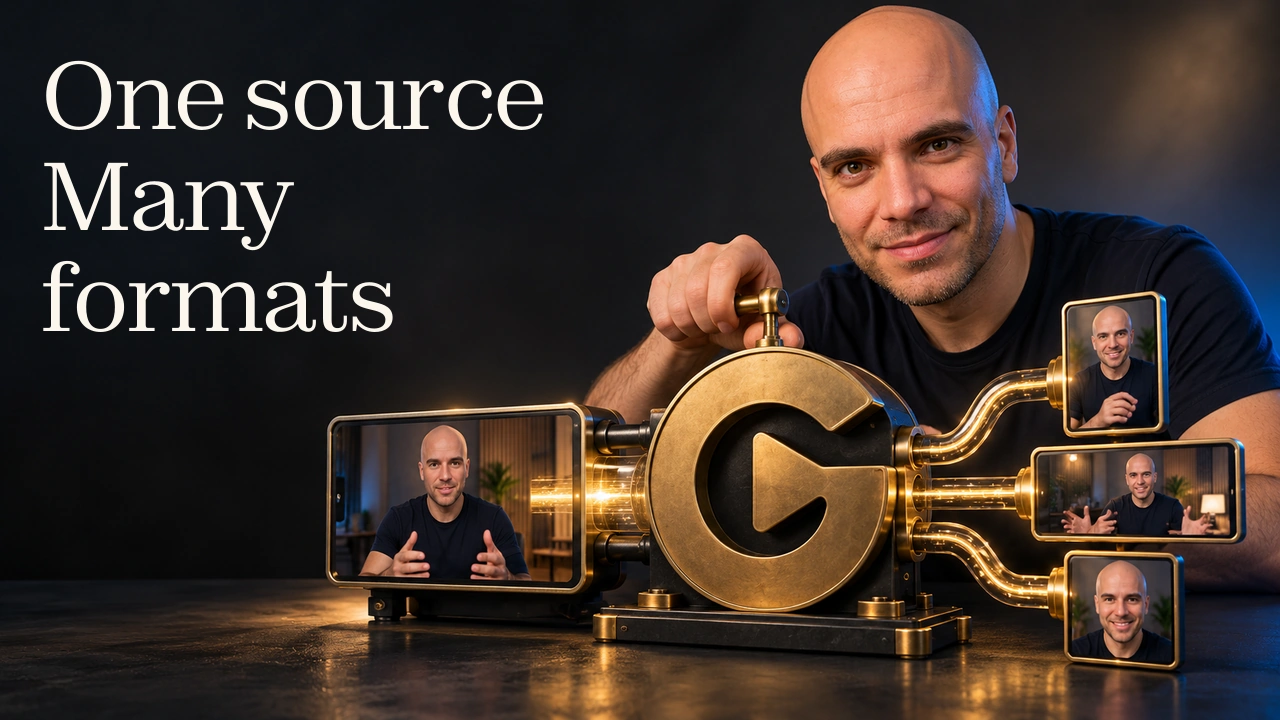
Read the guide, then turn it into a concrete plan for your brand.
Content repurposing is not a volume trick. It is a way to extract the full value of an expensive source while adapting the idea to how people actually consume each channel.
The common failure is generating dozens of near-identical captions. A useful system identifies claims, stories, examples, and objections, then gives each derivative one audience and one job.
The short answer
The best repurposing tool depends on the source. Genfeed is strongest when one source must become several governed formats; Descript and Riverside are useful around recorded audio and editing; OpusClip focuses on finding short video moments; Repurpose.io focuses on distribution workflows. Judge the complete route from source rights to approved variants.
Choose the workflow before the tool
A tool list is useful only after the operating constraint is clear. Decide who owns the brief, what must remain consistent, where approval happens, and which result will be measured. Otherwise a team buys overlapping generators and still moves copy between tabs by hand.
| Option | Best fit | Trade-off to accept |
|---|---|---|
| Genfeed | Turning source material into coordinated copy, images, video briefs, and posts | Best results require a defined brand and review workflow |
| Descript or Riverside | Transcript-led audio and video editing | Cross-format campaign operations may sit elsewhere |
| OpusClip | Finding and formatting short clips from long video | Clip selection is only one part of repurposing |
| Repurpose.io | Moving completed media between channel destinations | Distribution automation does not create the editorial angle |
Start by atomizing the source
Break the source into claims, examples, stories, instructions, objections, and quotable language. Keep timestamps and links so every derivative can be checked against the original.
This source map is more valuable than a single summary. It lets the team choose an idea deliberately and prevents a language model from flattening the speaker’s strongest distinctions.
Give every format a native job
A short clip earns attention through a complete moment. A carousel teaches a sequence. A LinkedIn post frames an opinion. A newsletter can add context and a direct relationship. The source is shared; the editorial contract is not.
Write a micro-brief for each derivative with channel, audience state, hook, evidence, and next action. That is the difference between repurposing and duplication.
Preserve lineage and rights
Store the source id, transcript range, contributor permissions, music rights, and approved derivative with the asset. If a source changes or must be withdrawn, the team can find every dependent item.
This lineage also improves learning: analytics can be rolled back to the source idea rather than reviewed as disconnected posts.
A repeatable implementation workflow
Run the first version manually and keep the hand-offs visible. Automation should remove a proven bottleneck, not hide an undefined process. Each step below needs an owner, an input, an output, and a clear reason to stop for human review.
- Ingest and transcribe. Preserve the original file, speaker labels, timestamps, and usage rights.
- Build a source map. Identify standalone claims, examples, stories, and demonstrations.
- Assign derivative jobs. Choose audience, channel behavior, format, and CTA for each candidate.
- Generate and edit. Create drafts, verify against source, then apply brand and platform rules.
- Publish and roll up learning. Track performance by derivative and by the original idea.
How this fits into Genfeed
Genfeed is designed as a content operating system rather than a single generator. A brand keeps its voice, visual references, prompts, assets, content plans, approvals, and publishing work in one tenant-aware workspace. Teams can choose models per job instead of rebuilding the workflow whenever a model changes.
Start with the Genfeed workspace, then use the documentation for self-hosting, integrations, API, and MCP setup. The practical goal is traceability: a reviewer should be able to see which brief produced an asset, which brand rules applied, what changed during approval, and where the final version was distributed.
What to measure
Measure the workflow as well as the post. Reach without production context cannot tell you whether the system improved. Capture a baseline for one normal week, then compare the same content type and channel after the new process has run for at least two cycles.
- Approved derivatives per source asset
- Incremental reach without audience fatigue
- Correction time caused by lost source context
- Conversion and assisted-conversion rate by derivative type
Keep quality and efficiency in the same scorecard. A faster workflow that doubles corrections is not faster; a beautiful asset that misses the campaign deadline is not effective. Record both the audience result and the human effort required to achieve it.
Common mistakes
- Treating transcript chunks as finished posts
- Publishing a clip whose claim depends on missing context
- Removing attribution to the source asset
- Optimizing derivative count instead of audience value
The pattern behind these failures is premature scale. Teams automate volume before they have a stable brief, approval rule, naming system, or feedback loop. Fix the smallest broken hand-off first, document it, and only then increase the number of channels or variants.
Operator checklist
- The audience, job, channel, and desired action are explicit in the brief.
- Brand voice and visual constraints are attached as references, not remembered from chat.
- Every generated claim, likeness, and licensed asset has a review owner.
- The approval state is visible and the published version is immutable.
- Platform-specific crops, captions, alt text, and safe zones are checked.
- UTM naming and success metrics are defined before distribution.
- The team records what failed so the next brief improves.
Frequently asked questions
Is repurposing the same as cross-posting?
No. Cross-posting sends the same asset elsewhere. Repurposing re-expresses one source for a different audience, format, moment, and channel behavior.
How much content can one podcast create?
The useful number is set by distinct ideas, not an arbitrary quota. A strong hour may support several clips, posts, a newsletter, and an article if each stands alone.
Should AI select every clip?
Use AI for candidate discovery and transcripts, then have an editor verify context, pacing, and whether the excerpt makes a complete promise.
How do you avoid repetitive feeds?
Assign each derivative a different job—teach, challenge, prove, summarize, or invite—while keeping the source thesis consistent.
Continue building the system
- Explore the Genfeed content operating system
- Read the Genfeed documentation
- Review the open-source repository
Sources and further reading
Product capabilities and platform rules change. The links below point to first-party documentation or the vendor pages used for this guide; verify the current limits before committing budget or production volume.