
How Agencies Can Manage Multiple Brands With AI Content Workflows
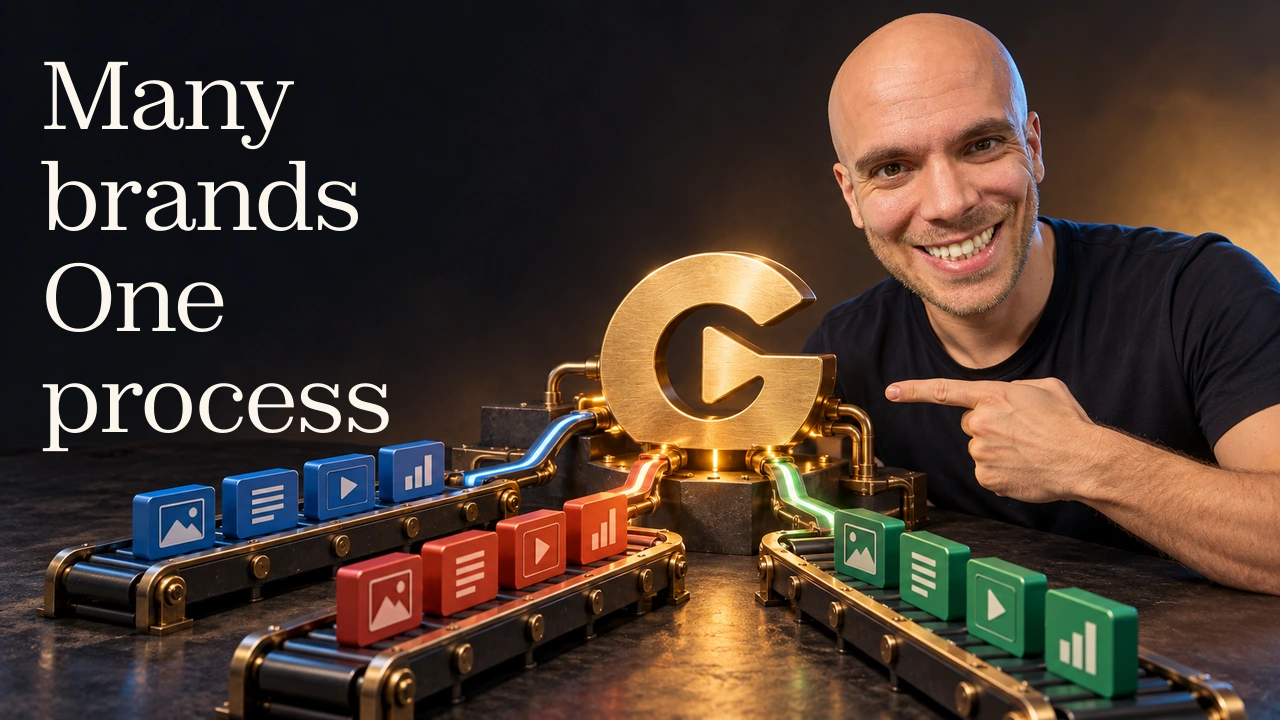
Reuse agency process while isolating every client’s brands, assets, credentials, approvals, budgets, destinations, and reporting.
Read the guide, then turn it into a concrete plan for your brand.
Multi-brand agency work creates an appealing but risky automation target. The same team repeats similar production stages while every client has different truth, permissions, credentials, and consequences.
The architecture should maximize reusable process while making cross-client data leakage and wrong-destination publishing structurally difficult.
The short answer
Agencies should use one reusable operating model with strict per-client organization and brand boundaries. Standardize workflow templates, taxonomies, quality rubrics, and reporting; isolate client data, credentials, source material, approvals, model budgets, and publishing destinations. Shared process is efficient. Shared tenant state is dangerous.
Choose the workflow before the tool
A tool list is useful only after the operating constraint is clear. Decide who owns the brief, what must remain consistent, where approval happens, and which result will be measured. Otherwise a team buys overlapping generators and still moves copy between tabs by hand.
| Option | Best fit | Trade-off to accept |
|---|---|---|
| Organization per client | Strong separation of members, data, billing, and governance | Cross-client operations require admin-level views |
| Brand per client line | Several brands governed by one client organization | Permissions may need brand-level detail |
| Shared workflow templates | Consistent delivery stages across accounts | Templates must not embed tenant data |
| Custom client workflow | Regulated, unusual, or high-value engagements | Higher maintenance and training cost |
Separate global method from tenant truth
Global artifacts can define stages, required fields, QA rubrics, and generic prompt structures. Tenant artifacts contain brand voice, references, claims, sources, destinations, budgets, and performance.
At run time, the system hydrates a template inside one authorized organization and brand. It never copies the tenant context back into the template.
Design the operator experience for context safety
Display the active client and brand around every generation, review, credential, and publishing action. Require confirmation when a destination changes or a bulk action spans brands.
Admin views can aggregate operational status while detail edits route into the canonical tenant-aware editor.
Report value and cost at the same boundary
Attach model usage, production time, approvals, publications, and results to the client and campaign. This supports transparent reporting and exposes unprofitable revision patterns.
Benchmark workflows without exposing one client’s content or performance details to another.
A repeatable implementation workflow
Run the first version manually and keep the hand-offs visible. Automation should remove a proven bottleneck, not hide an undefined process. Each step below needs an owner, an input, an output, and a clear reason to stop for human review.
- Model client ownership. Map organizations, brands, members, roles, credentials, billing, and destinations.
- Extract safe templates. Standardize stages and rubrics without embedding tenant-specific examples.
- Enforce scope server-side. Apply organization, brand, user, and soft-delete guards to reads, writes, jobs, and tools.
- Make context visible. Show the active client around every consequential operator action.
- Lock and deliver per tenant. Publish only approved versions through that tenant’s credential.
- Report at the same boundary. Attribute cost, output, performance, and revisions to the owning client.
How this fits into Genfeed
Genfeed is designed as a content operating system rather than a single generator. A brand keeps its voice, visual references, prompts, assets, content plans, approvals, and publishing work in one tenant-aware workspace. Teams can choose models per job instead of rebuilding the workflow whenever a model changes.
Start with the Genfeed workspace, then use the documentation for self-hosting, integrations, API, and MCP setup. The practical goal is traceability: a reviewer should be able to see which brief produced an asset, which brand rules applied, what changed during approval, and where the final version was distributed.
What to measure
Measure the workflow as well as the post. Reach without production context cannot tell you whether the system improved. Capture a baseline for one normal week, then compare the same content type and channel after the new process has run for at least two cycles.
- Gross margin and approved output by client
- Cross-tenant access or destination incidents
- Template reuse without client-specific leakage
- Cycle time and revision rate by workflow and brand
Keep quality and efficiency in the same scorecard. A faster workflow that doubles corrections is not faster; a beautiful asset that misses the campaign deadline is not effective. Record both the audience result and the human effort required to achieve it.
Common mistakes
- Using the last selected brand as a security boundary
- Embedding client examples in global templates
- Sharing provider credentials across unrelated organizations
- Aggregating analytics without preserving client ownership and consent
The pattern behind these failures is premature scale. Teams automate volume before they have a stable brief, approval rule, naming system, or feedback loop. Fix the smallest broken hand-off first, document it, and only then increase the number of channels or variants.
Operator checklist
- The audience, job, channel, and desired action are explicit in the brief.
- Brand voice and visual constraints are attached as references, not remembered from chat.
- Every generated claim, likeness, and licensed asset has a review owner.
- The approval state is visible and the published version is immutable.
- Platform-specific crops, captions, alt text, and safe zones are checked.
- UTM naming and success metrics are defined before distribution.
- The team records what failed so the next brief improves.
Frequently asked questions
Can one operator work across clients?
Yes, through explicit memberships and a superadmin or agency view. Every action should still resolve and display the active client and brand.
Can prompts be shared?
Generic methods can be templates. Client voice, examples, source material, claims, and performance data must stay scoped to that client.
How should model costs be allocated?
Record usage against the organization, brand, run, and asset so agency margin and client reporting are grounded in approved output.
What is the biggest operational risk?
Publishing or exposing the right content in the wrong tenant. Defense requires server-side scoping, visible context, and tests at every read and write boundary.
Continue building the system
Sources and further reading
Product capabilities and platform rules change. The links below point to first-party documentation or the vendor pages used for this guide; verify the current limits before committing budget or production volume.